
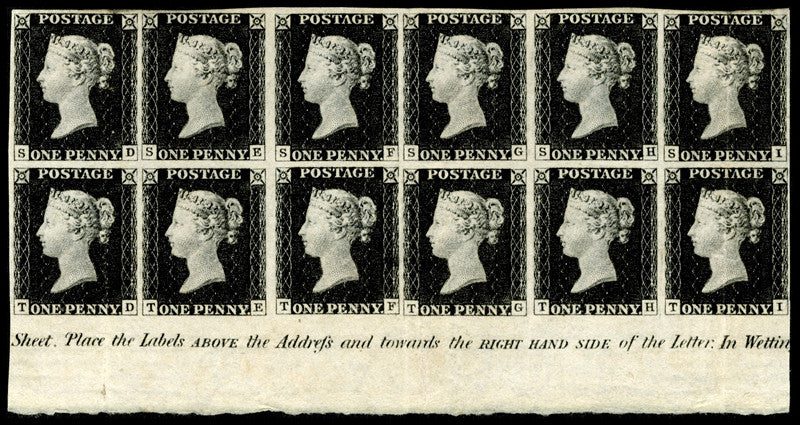
The Penny Black, issued in 1840, was the world’s first adhesive postage stamp, revolutionizing communication by making mail delivery affordable, standardized, and accessible to all.
Before 1840, the British postal system was complex and costly. Recipients, not senders, often paid postage, with fees calculated by distance and the number of sheets. This system discouraged widespread use. Reform came through Sir Rowland Hill, who in 1837 proposed a prepaid adhesive stamp to simplify and democratize postal services.
The government adopted Hill’s idea, and after a design competition failed to produce a suitable entry, a simple yet iconic design was chosen: a profile of Queen Victoria, engraved by Charles and Frederick Heath from a sketch by Henry Corbould, itself based on William Wyon’s 1834 medal portrait.
Design and Features
- Appearance: The Penny Black depicted Queen Victoria’s left-facing profile, with the inscriptions POSTAGE above and ONE PENNY below.
- Dimensions: Approximately 19 × 22 mm, printed in black ink.
- Forgery Prevention: Each stamp bore unique corner letters indicating its position on the sheet of 240 stamps. Intricate background patterns and watermarked paper further deterred counterfeiting.
- Printing: Produced by Perkins, Bacon & Co. in London, with over 68 million copies printed between May 1840 and February 1841.
The Penny Black introduced the Universal Penny Post, allowing letters up to half an ounce (14 g) to be sent anywhere in the British Isles for a flat rate of one penny. This innovation:
- Made postal services affordable to ordinary citizens.
- Standardized rates regardless of distance.
- Encouraged literacy, correspondence, and commerce.
Its success was immediate, with printers producing up to 600,000 stamps daily.
Despite its success, the Penny Black had one flaw: the red cancellation ink used to mark stamps was easily removed, enabling reuse. To solve this, the stamp was replaced in 1841 by the Penny Red, which used black cancellation ink that was harder to erase.
Although millions were printed, only about 1.3 million Penny Blacks survive today, making them highly prized by philatelists. Values vary widely depending on condition, ranging from £40 to several thousand pounds.
The Penny Black’s legacy endures as a symbol of innovation. It not only transformed postal systems but also established the tradition of featuring monarchs on British stamps—a practice that continues to this day.
The Penny Black was more than just a stamp; it was a social and technological milestone. By simplifying communication, it helped knit together communities, fostered economic growth, and set the stage for modern postal systems worldwide. Its enduring appeal lies in both its historical significance and its elegant design, making it a cornerstone of philatelic history.
* Check out a great Penny Black gift from our collection!